
I grew up in the Midwest where bacon was basically a food group and the default cooking method was, well, “fry it until it behaves.” When I switched to an air fryer, bacon was one of the first things I tried and one of the first things I messed up. My early batches were a mix of curled ends, smoky splatter, and one memorable incident where a strip glued itself to the basket like it paid rent.
Now it’s one of my favorite air fryer wins because it’s fast, hands-off, and consistently crispy with way less mess. The key is arranging the strips so the fat has time to render before the skinny ends get overdone.
Before you start: two rules for flat bacon
1) Shorten the strip instead of forcing it
If your bacon is longer than your basket, don’t mash it into a “U” that presses against the walls. Those lifted ends are what burn first. Instead:
- Make a gentle accordion fold (one or two soft bends) so the strip lies flat on the bottom.
- Or cut strips in half for more even cooking and easier breakfast sandwiches.
2) Give the ends a buffer zone
In many air fryers, the edges brown faster than the center. Leave a little breathing room at the perimeter so the tips aren’t sitting right up against the side wall. I aim for about 1/4 to 1/2 inch of space between bacon ends and the basket edge.
Best temp for air fryer bacon
I keep it simple. These are typical starting ranges, but air fryers vary a lot by basket shape, fan strength, and wattage, so check early the first time you try a new machine or brand.
- 350°F for more control and chewier bacon, especially thick-cut or sugar-cured.
- 375°F for most everyday bacon you want crisp.
- 400°F when you want it extra-crispy and fast, or when you’re finishing a batch that’s already mostly rendered.
If your air fryer runs hot (many do), start at 350°F the first time. You can always bump it up.
Cook times
Air fryers vary, bacon brands vary, and thickness varies, so think of these as starting ranges. The doneness changes fast in the last 2 minutes, so stay close. For a brand-new setup, I like to check thin-cut around 6 minutes at 375°F.
| Doneness | Thin-cut bacon | Thick-cut bacon | Temp |
|---|---|---|---|
| Chewy (still bendy) | 6 to 8 minutes | 9 to 12 minutes | 350°F |
| Crisp (snaps, not brittle) | 8 to 10 minutes | 12 to 15 minutes | 375°F |
| Extra-crispy (very brittle) | 10 to 12 minutes | 15 to 18 minutes | 400°F |
Important: Bacon firms up as it cools. If it looks “almost there” in the basket, it’s usually perfect after 2 minutes on a paper-towel-lined plate.
How to arrange bacon evenly
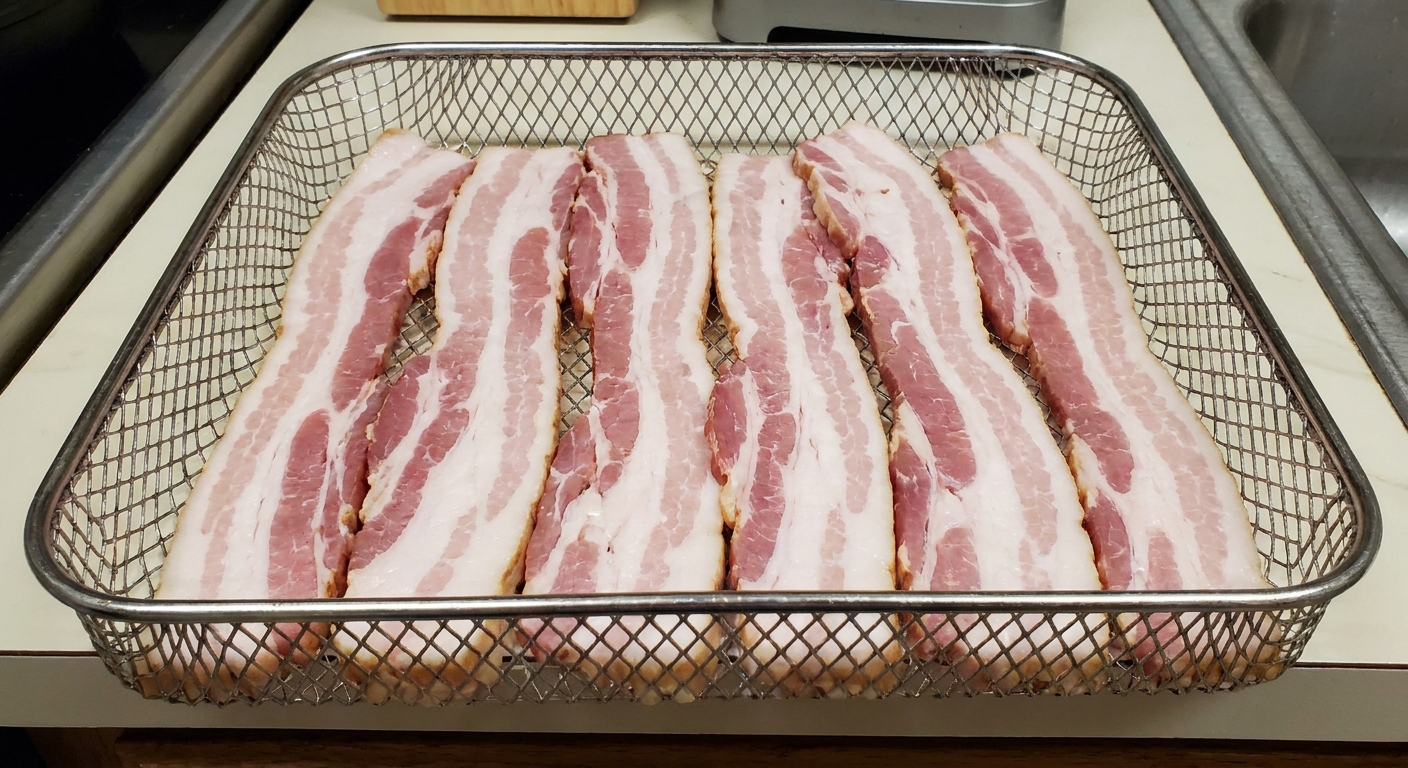
Single layer is king
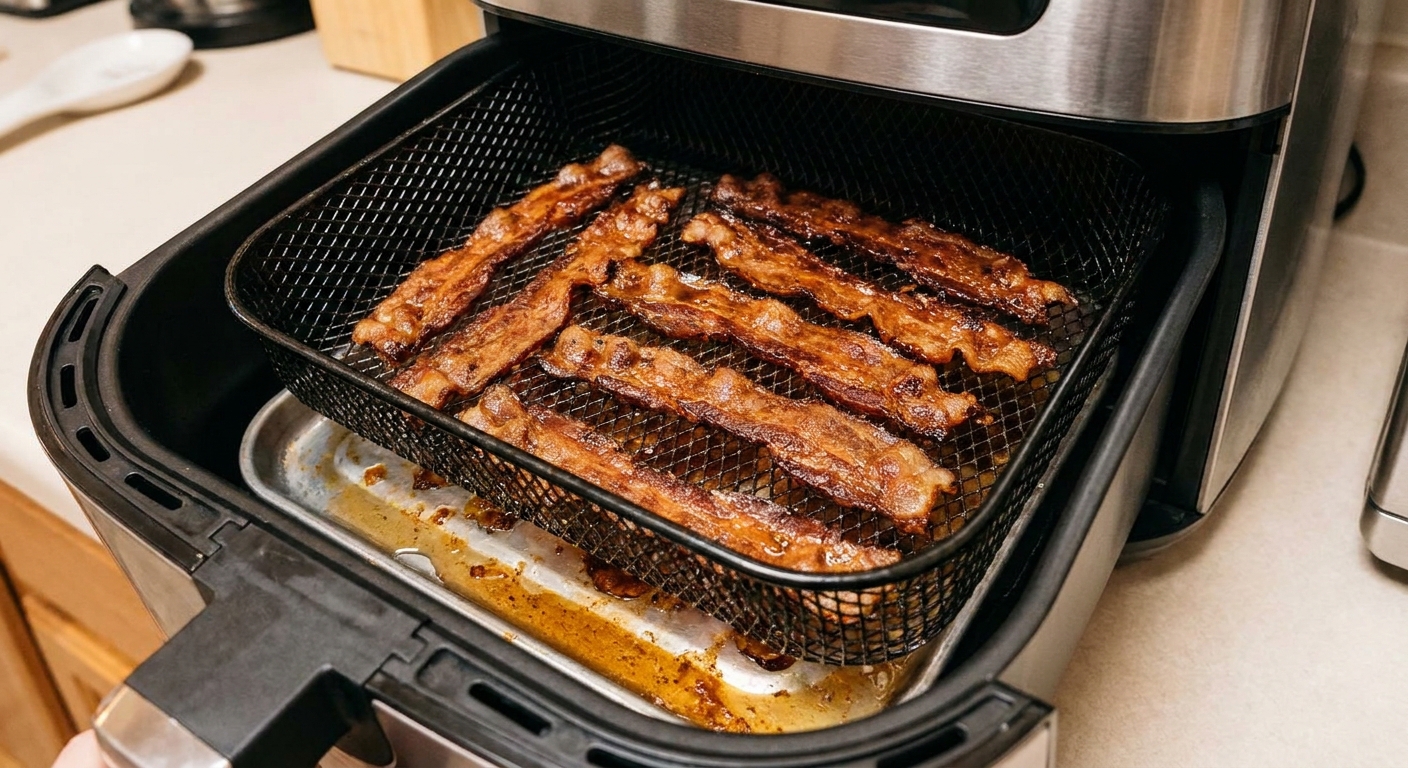
Lay strips in a single layer with minimal overlap. A little touching is fine. Actual stacking is what causes half-steamed, half-burnt bacon.
For extra-long strips: the center tuck
Instead of curling both ends up, tuck just one end about 1 to 2 inches toward the center so the whole strip stays flat. The goal is flat contact with the basket, not a bacon hammock.
If you have a rack, use it carefully
A rack can help airflow, but bacon can also whip around in strong fans. If you use a rack, make sure strips are secure and still mostly flat. I personally prefer the basket bottom for the flattest strips.
Batch sizing: If you’re trying to feed a crowd, you’ll get better bacon by cooking in rounds rather than overcrowding. Overcrowding blocks airflow and makes the hot spots worse.
Do you need to flip bacon?
Usually, yes, once. Flipping gets you more even browning and helps the top fat render instead of bubbling.
- Thin-cut: flip at the halfway mark (around 4 to 5 minutes at 375°F).
- Thick-cut: flip after it has started to shrink and look slightly wavy (around 7 to 8 minutes at 375°F, or later if cooking at 350°F).
If your strips are very flat and your air fryer browns evenly, you can skip flipping, but check the first time so you know how your machine behaves.
Grease and smoke
Bacon will render a surprising amount of fat, especially thick-cut. In a basket-style air fryer, most of it drains down, which is exactly why bacon gets so crisp.
How much grease to expect
- Thin-cut: moderate grease, usually manageable for one batch without draining.
- Thick-cut: a lot of grease. If you’re doing multiple rounds, plan to carefully pour off the drip tray between batches once it cools slightly.
Smoke control tips
- Start at 350°F if your bacon is particularly fatty, sugar-cured (maple, brown sugar), or your air fryer tends to smoke at higher temps.
- If your manual allows it, add a splash of water (1 to 2 tablespoons) to the bottom drip tray under the basket to help cool drippings and reduce smoke. Keep water away from any heating element, and skip this if your manufacturer warns against adding liquid.
- Skip aerosol cooking sprays on some nonstick baskets because certain propellants and additives can damage some coatings. If you’re unsure, check your manual. Bacon doesn’t need it anyway.
Step-by-step method
- Preheat (optional): If your air fryer preheats fast, do 2 to 3 minutes at your target temp. If you forget, it’s fine. Bacon is forgiving.
- Arrange bacon: Single layer, ends tucked inward, with a small gap from the basket walls.
- Air fry: Use the time ranges above, but check early on your first run.
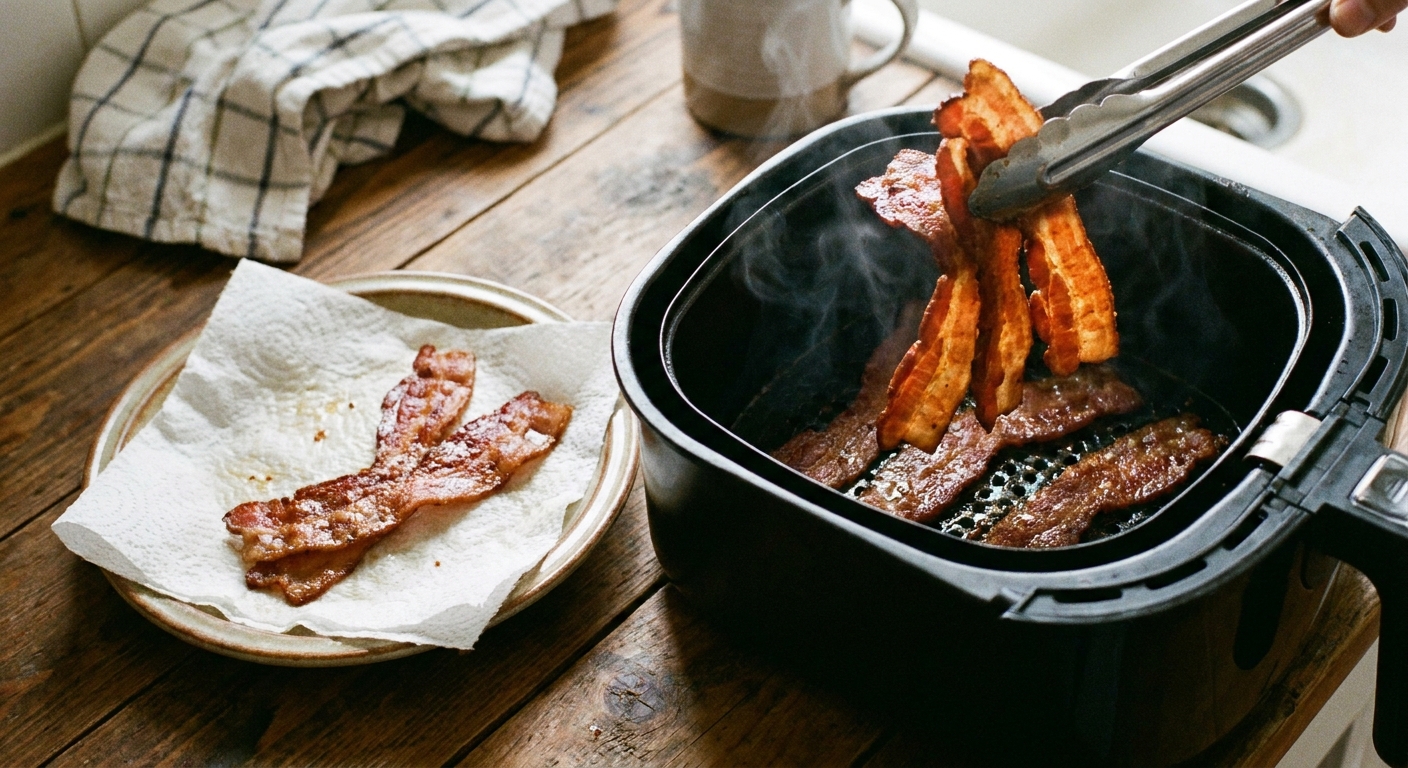
- Flip once: Use tongs. Bacon and hot grease are not the moment for fingers.
- Drain: Transfer to a paper-towel-lined plate for 1 to 2 minutes to crisp up.
- Repeat: For another batch, pour off excess grease if it’s pooling high in the bottom.
Fix common problems
“My bacon curled and the tips burned.”
- Lower the temp to 350°F and cook a bit longer.
- Keep strips away from the basket wall and avoid tight U-shapes.
- Try cutting strips in half for the most even results.
“It’s cooked but not crisp.”
- It may just need 2 minutes to cool. Crispness sets as the fat firms.
- If it’s truly soft, re-crisp using the method below.
“It tastes dry.”
- Drop to 350°F and aim for chewy or just-barely crisp. Overcooked bacon goes from crispy to dusty fast.
- Thick-cut is easier to keep juicy inside. If you love thick bacon, don’t rush it at 400°F from the start.
How to re-crisp bacon
This is my favorite air fryer magic trick: bacon that went limp on the plate becomes crisp again in minutes.
- Temp: 350°F
- Time: 2 to 4 minutes for a small batch, 4 to 6 minutes for a fuller basket
- How: Single layer, no overlap if possible. No need to flip unless strips are thick.
Watch closely. Already-cooked bacon can jump from revived to overdone very quickly.
Thin vs thick-cut
Thin-cut bacon
- Cooks fast and can go from perfect to too dark quickly.
- Benefits from lower temps if you want even browning without bitter edges.
- Flipping halfway is usually enough.
Thick-cut bacon
- Needs time for the fat to fully render, otherwise it can look brown but still feel rubbery.
- Does best starting at 350°F, then finishing at 375°F or 400°F if you want it very crisp.
- Sometimes needs a second flip if the top is lagging behind.
Safety and cleanup
- Hot grease is real. Let the basket sit for a minute before you move it, and pour drippings only when they’re not aggressively bubbling.
- Don’t dump grease down the sink. Pour into a heat-safe container and discard when cool, or strain and save for cooking if that’s your thing.
- Wash soon. Bacon fat gets stubborn as it cools. A warm soapy soak is your friend.
FAQ
Should I put foil or parchment under bacon?
Usually no. Bacon crisps best when the grease can drain away. If you line the basket bottom, you can trap grease around the bacon and make it cook unevenly. If you’re trying to reduce smoke, a small splash of water in the drip tray (beneath the basket) is often more effective than liners, as long as your manual allows it.
Can I stack bacon?
I don’t recommend it. Stacked bacon steams where it overlaps and crisping becomes patchy. If you need a bigger quantity, cook in batches. The good news is it’s fast.
What about maple, brown sugar, or peppered bacon?
These often brown faster because of sugar and coatings. I start at 350°F and keep a closer eye in the last few minutes, especially around the edges.
What if my air fryer is an oven-style model?
Use a tray with a rack if you have it, and rotate the tray once during cooking for even browning. Keep an eye on grease drips and use a pan below to catch them.
Why is it splattering so much?
Some splatter is normal. Very fatty bacon splatters more, and higher temps increase it. Try 350°F and longer cooking, and make sure the bacon is in a single layer so fat can drip away instead of bubbling on top.